Most quotation disputes in interior design don't come from a wrong number - they come from a missing line. A validity date nobody set, an exclusion nobody wrote down, a "final" figure that quietly excluded false ceiling work. By the time a client notices, you're negotiating a discount instead of pointing to a document.
This guide covers what an interior design quotation actually is, how it differs from an estimate (and from a BOQ), what a properly structured one should include for Indian studios specifically, and the handful of mistakes that account for most of these disputes.
What Is an Interior Design Quotation?
An interior design quotation is a written commercial offer - usually room-wise or category-wise - stating what a studio will deliver and at what price, submitted before a client commits to a project. It's the first real money document in the project lifecycle: before a quotation, you're discussing a brief; after one is signed, you have a scope and a number both sides agreed to.
A good quotation isn't just a total. At minimum it should carry:
- Studio and client details, plus the site address
- A quotation number and issue date
- A validity period ("valid for 15 days from the date of issue")
- Room-wise or category-wise line items with a one-line description each
- What's explicitly excluded from the price
- The payment schedule (advance, milestone-linked instalments, final payment)
- GST treatment for the quoted amount
- A revisions clause - what happens, cost-wise, if the client asks for changes after signing
Skip any of these and you haven't written a weaker quotation - you've written a document with a gap a client can (and eventually will) argue through.
Quotation vs Estimate: Why the Difference Matters
These two words get used interchangeably in conversation, and that's exactly where disputes start.
An estimate is an approximate figure given early, often before a site visit or full brief - useful for a client deciding whether to proceed at all, but not something either side should treat as final. A quotation is a firm commercial offer: once a client accepts it, both sides are working against that number and that scope.
The dispute pattern is almost always the same: a designer gives a client a rough estimate over a call ("should be around ₹8-10 lakh for a 2BHK"), the client mentally locks onto the lower number, and by the time a proper quotation comes in at ₹11 lakh with a full scope attached, the client feels the price "went up" - when really, an estimate just became a quotation, and nobody explained that transition. Naming the document correctly, and being explicit about which stage you're in, prevents most of this before it starts.
Quotation vs BOQ: Where a Quotation Ends and a BOQ Begins
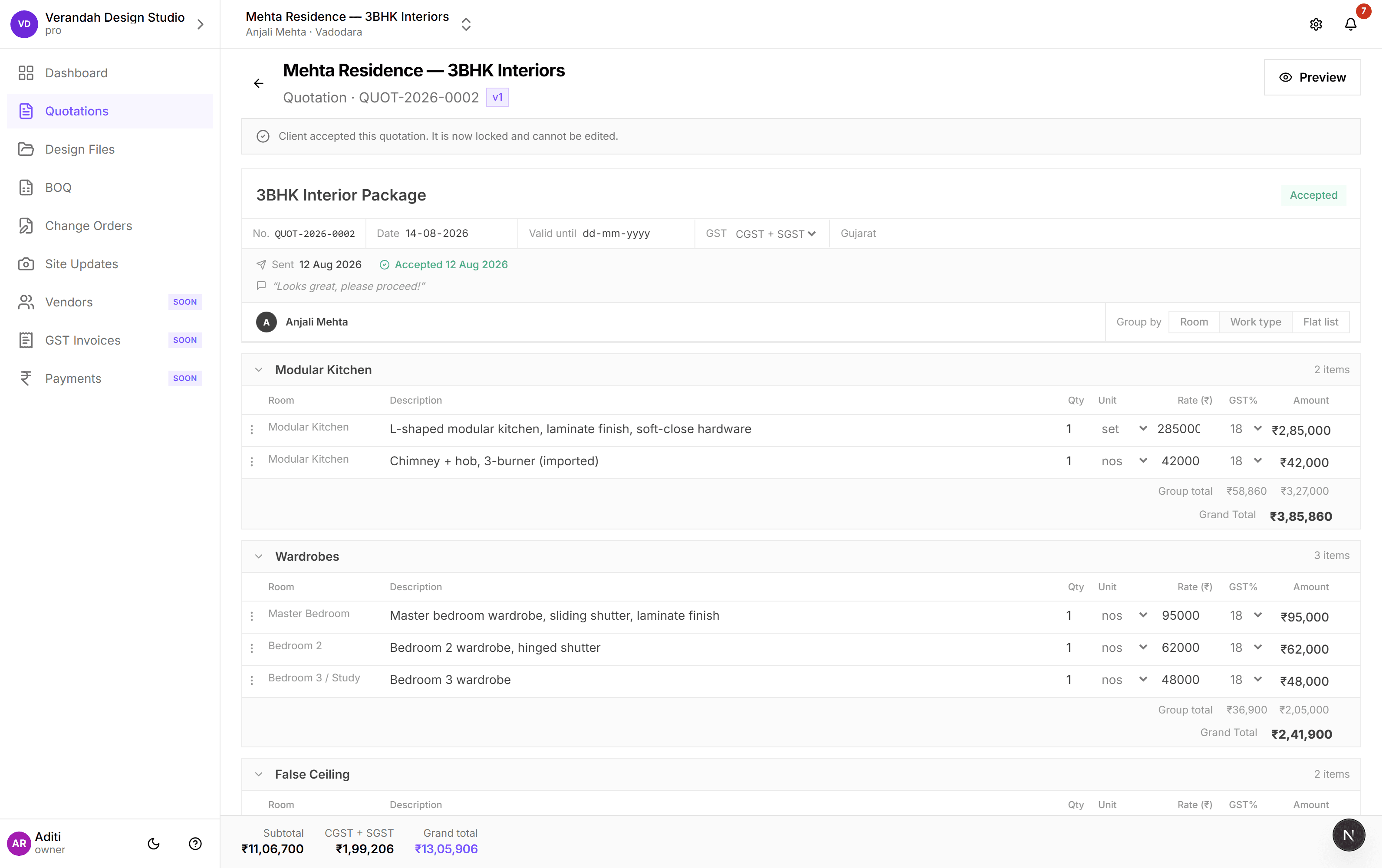
A quotation groups pricing by room or category - "modular kitchen: ₹4,20,000." A Bill of Quantities (BOQ) breaks that same number apart into every material, fitting, and work item behind it - 18mm BWP plywood at a per-sq.ft rate, soft-close hinges per piece, and so on - each line traceable to a vendor, a rate, and a quantity.
A quotation is what a client signs off on to start a project. A BOQ is what execution and vendor billing actually run on afterward. Many studios stop at a quotation and go straight to execution on a lump-sum figure - it's faster to write, but it's exactly how "the vendor bill doesn't match what we quoted" disputes happen, because there's no itemised document to check the vendor bill against.
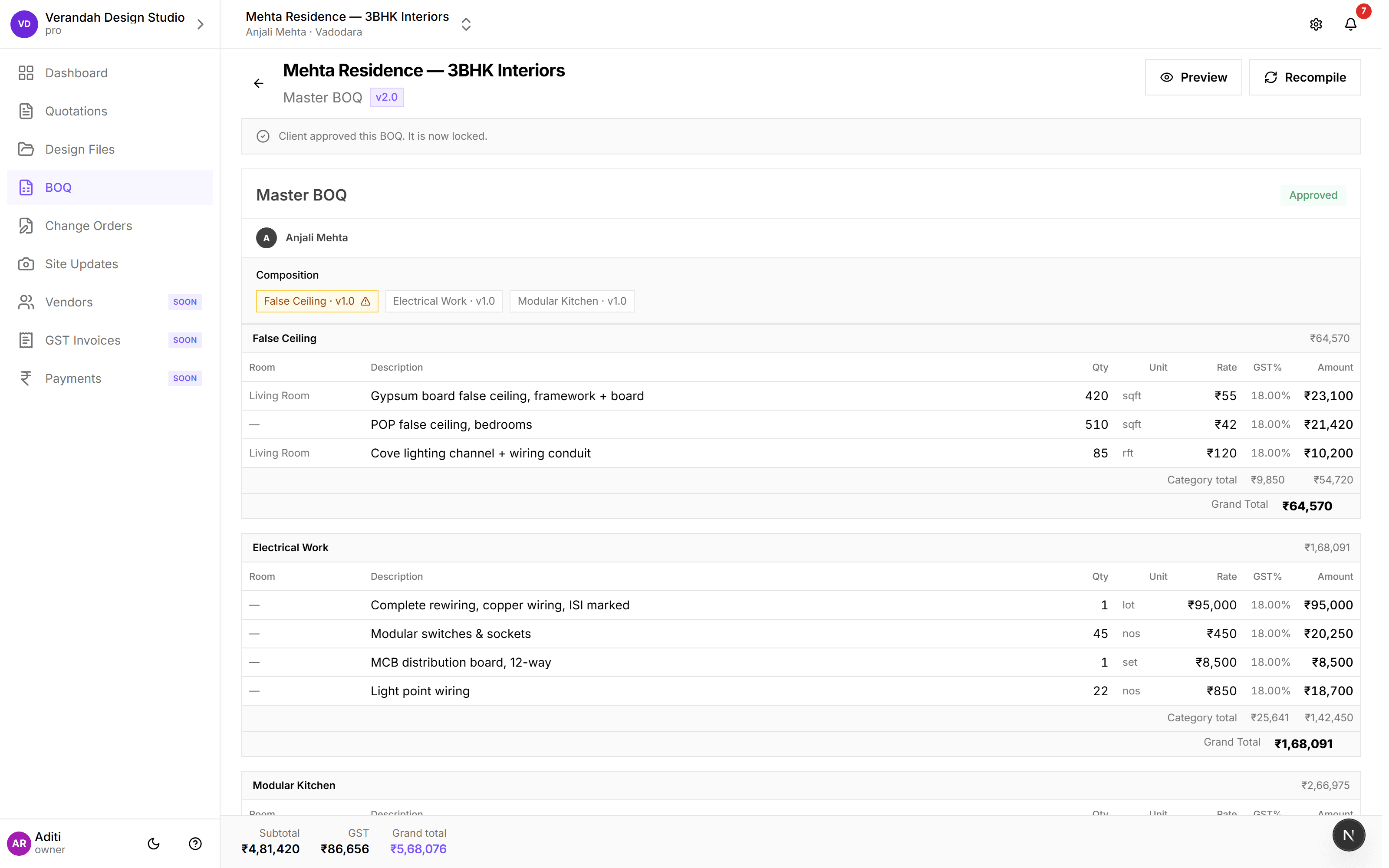
A quotation and the BOQ that follows it tend to drift apart the moment either one gets revised on its own. Vismayum's Quotation module supports room, category, or flat-rate grouping with full version history and a client-facing portal for approval - and once a quotation is accepted, one action converts it into per-trade Category BOQs and a compiled Master BOQ, so the two documents never lose their link back to each other.
See the Quotations workflowWhat a Proper Interior Design Quotation Should Include
1. Studio and client details
Studio name, address, GSTIN, and contact details, plus the client's name, contact, and the site address the quotation is for. Sounds obvious - it's also the first thing missing from quotations put together in a hurry over WhatsApp.
2. Quotation number, date, and validity
A quotation number matters the moment a client has seen more than one version of a quote (which is most clients). The validity period matters more: material and vendor rates move, and a quotation with no expiry is one a client can try to hold you to eight months later at old rates.
3. Room-wise or category-wise line items
Break the total down by room (living room, kitchen, bedrooms) or by category (civil, carpentry, electrical, furnishing) - not one lump figure. This is also what makes a quotation easy to convert into a BOQ later, since the BOQ's line items map back to the same groupings.
4. An explicit exclusions list
This is the single most commonly skipped section, and the single biggest source of "but I thought this was included" conversations. False ceiling, electrical fittings, civil work, painting, and appliances are common items studios assume are obviously separate - clients don't share that assumption unless it's written down.
5. Payment schedule
Advance percentage, milestone-linked instalments (on material delivery, on carpentry completion, on handover), and the final payment condition. Tying payments to milestones rather than to calendar dates protects both sides better if a project runs long.
6. GST treatment
State whether the quoted figure is inclusive or exclusive of GST, and at what rate. Interior fit-out and furniture work in India most commonly falls under 18% GST, though the exact classification (works contract vs. goods vs. services, and whether it's a residential or commercial project) can shift this - always confirm the applicable rate and SAC/HSN code with your CA rather than assuming one rate covers every project.
7. A revisions clause
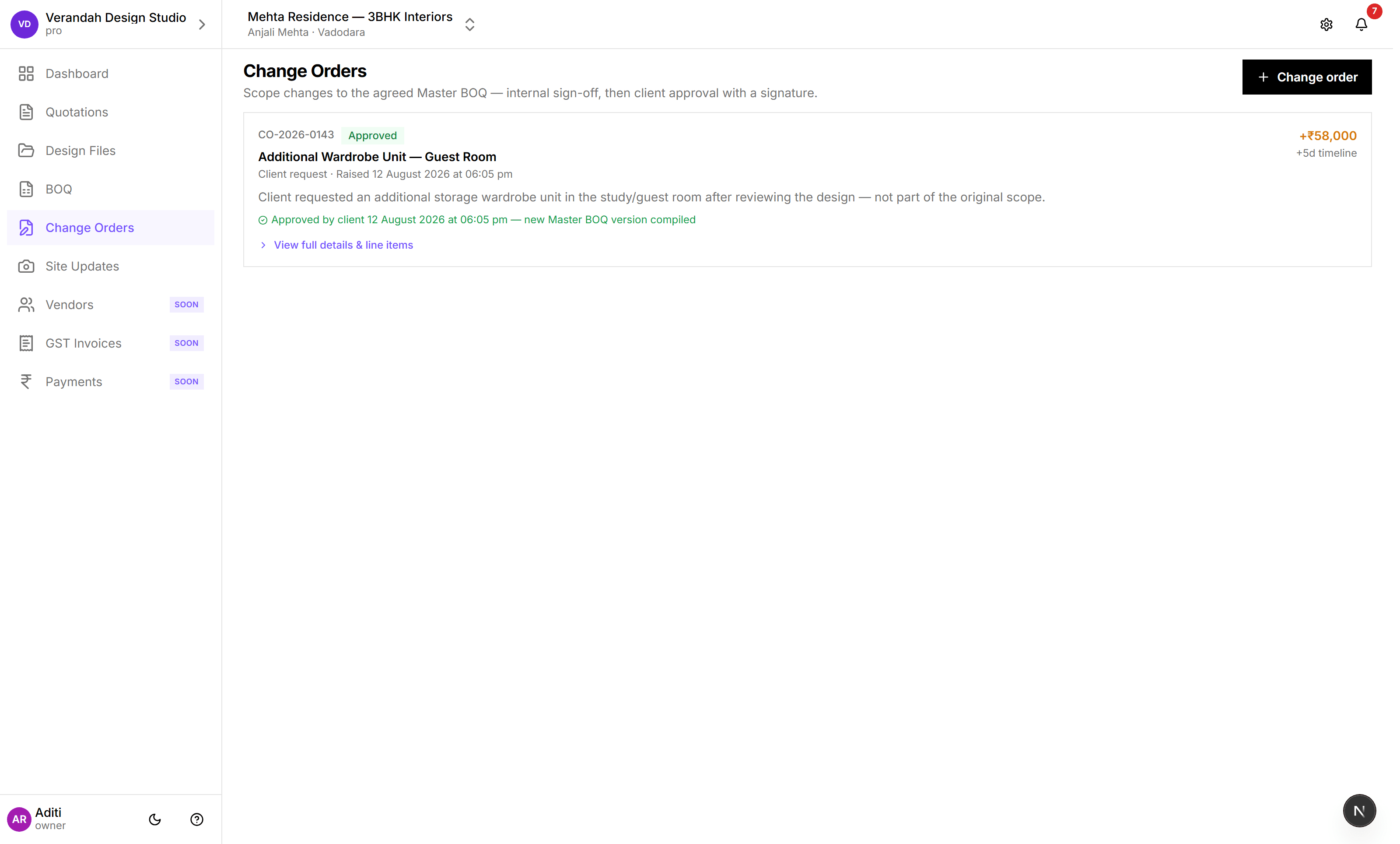
What happens, in writing, if the client asks for a material upgrade or scope change after signing. Studios that skip this end up either eating the cost of every "small change" or having an awkward, undocumented conversation about it mid-project. A one-line clause ("changes to scope or specification after acceptance will be documented and priced separately") turns that into a formality instead of a negotiation - and gives you a change order to point to instead of a memory.
A Simple Quotation Structure Example
| Section | What it contains |
|---|---|
| Header | Studio name, GSTIN, quotation no., date, validity |
| Client & site | Client name, site address, project type |
| Scope summary | One-line description of the overall project |
| Line items | Room/category-wise rows: description, unit, qty, rate, amount |
| Exclusions | Explicit list of what's not included |
| Payment schedule | Advance %, milestone instalments, final payment |
| Terms | GST treatment, validity, revisions clause |
| Sign-off | Studio signature/stamp + client acceptance |
A ready-made version of the structure above — room-wise line items with live GST/total formulas, an exclusions checklist, a milestone-linked payment schedule, and a sign-off block. Fill in your numbers, the rest calculates itself.
Common Mistakes That Turn a Quotation Into a Dispute
- No validity date. A quotation with no expiry can be held against you long after material rates have moved.
- No exclusions list. The single biggest cause of "I thought this was included" conversations.
- Lump-sum only, no room/category breakdown. Makes it impossible to isolate which part of a project actually changed when a client asks for a revision.
- No written revisions clause. Every mid-project change becomes a negotiation instead of a documented, priced update.
- Quotation and BOQ living in separate files with no link between them. Nobody notices when they've drifted apart until a client cross-checks the vendor bill against the original quote.
Frequently Asked Questions
Is an interior design quotation legally binding in India?
Once a client accepts a quotation in writing (signature, email confirmation, or an e-signed acceptance through a client portal), it functions as a binding commercial agreement on price and scope - which is exactly why the exclusions list, validity period, and revisions clause matter: they define the boundaries of what that binding agreement actually covers.
What's the difference between a quotation and an estimate?
An estimate is an approximate, early-stage figure that can still change as the brief firms up. A quotation is a firm commercial offer tied to a specific scope - once a client accepts it, both sides are working against that number. Treating an estimate as if it were a quotation (or vice versa) is a common source of client disputes.
Can a quotation be converted directly into a BOQ?
Yes, and it should be - a quotation's room or category totals are the natural starting point for a BOQ's itemised breakdown. Doing this by hand across two separate files is where the two documents tend to drift apart; some studio-management platforms, including Vismayum, support converting an accepted quotation directly into per-trade Category BOQs and a compiled Master BOQ in one step, keeping both documents traceable to each other.
What GST rate applies to an interior design quotation?
Most interior fit-out and furniture work in India attracts 18% GST, but the exact rate depends on classification - whether the work is billed as a works contract, as goods, or as a service, and whether the project is residential or commercial. Always confirm the applicable rate and SAC/HSN code with your CA before finalising a quotation, rather than assuming a single rate applies across every project type.