Every interior design project has a moment where the plan and reality stop agreeing with each other. A wall opens up and there's old plumbing behind it. A client sees the 3D render and decides the TV unit should be 2 feet longer. A vendor calls to say the imported laminate is out of stock and the alternative costs 15% more. None of this means the project went wrong - it means the project is real. What decides whether it costs you money or makes you money is whether that change gets written down before the work happens, or gets absorbed silently and discovered at final billing.
That written-down version has a name: a change order. This guide covers what one actually is, what triggers it, what a good one contains, and the step-by-step process for getting it approved - without turning every minor tweak into a 40-minute paperwork exercise.
What Is a Change Order in Interior Design?
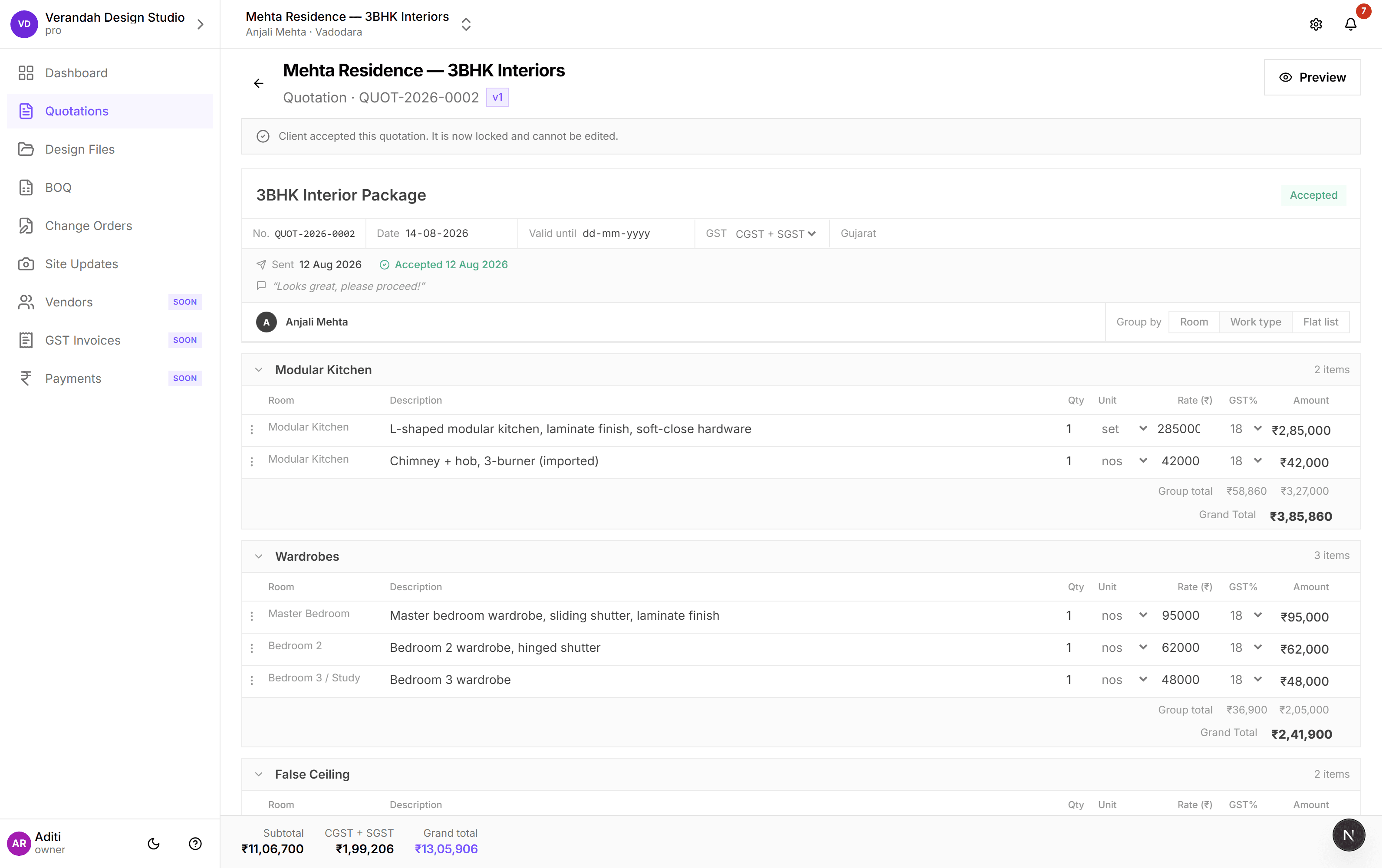
A change order is a documented, priced modification to work that's already been agreed - after a quotation is signed and, in most studios' workflow, after a Master BOQ has been approved. It records what's changing, why, what it costs, and who signed off on it, so the change becomes part of the project's official scope instead of a verbal understanding that two people remember differently three weeks later.
The critical word is after. If a client hasn't approved anything yet, you're still in the quotation or BOQ negotiation stage - there's nothing to change an order from. A change order only exists once there's a baseline to change against.
Why Change Orders Matter for Indian Studios
Indian interior design projects run on a mix of site-built work (civil, electrical, false ceiling) and factory-made modular units, executed over months with multiple vendors touching the same rooms. That combination produces change requests constantly - far more than a fully prefabricated or single-contractor project would. A studio without a change order discipline ends up in one of two bad places:
- Absorbing the cost silently, because there's no clean record of what was agreed versus what was added, and raising it after the fact feels awkward or looks like padding the bill.
- Fighting about it at final invoicing, because the client remembers a WhatsApp message saying "sure, go ahead" and doesn't remember agreeing to a price.
Neither outcome is really about the client being unreasonable - it's about the studio not having a system that turns a spoken change into a priced, approved document at the moment it happens.
Change Order vs Scope Creep vs Revision: What's the Difference?
These three get used interchangeably, but they're not the same thing, and mixing them up is where studios lose money.
| Term | What it means | What should happen |
|---|---|---|
| Revision | A change made before the client has approved anything - swapping a fabric option during design development | Free, expected, part of the design process |
| Scope creep | Small additions accepted informally, with no individual change ever priced or documented | The failure mode - this is what change orders exist to prevent |
| Change order | A priced, documented, approved modification to work already agreed | The correct way to handle any post-approval change |
Scope creep isn't a category of change - it's what happens when real changes go through without becoming change orders. Every "just add this small thing" that skips documentation is scope creep in progress, one small addition at a time, until the gap between what was quoted and what was built is large enough to notice.
What Triggers a Change Order
A few patterns cover most of what actually shows up on Indian interior fit-out projects:
- Site conditions discovered mid-execution - old wiring, uneven flooring, structural elements not visible until a wall or false ceiling is opened up.
- Client-initiated changes - after seeing the space in person or in a 3D render, a client decides a unit should be a different size, a material should be upgraded, or a room needs an item that wasn't in the original scope.
- Vendor or material changes - the specified laminate, hardware, or fabric goes out of stock or has a rate revision, and the substitute costs (or saves) money.
- Added scope mid-project - a room gets added to the engagement, or an existing room's brief expands, after the Master BOQ is already approved.
None of these are avoidable by planning harder - they're the normal texture of a multi-month, multi-vendor execution. The only thing that changes the outcome is whether each one gets turned into a documented change order at the point it happens.
What a Good Change Order Should Include
A change order that actually protects both sides needs to answer the same questions a BOQ line answers, plus one more - what changed and why:
- What's changing - the specific item(s), tied to a room where relevant
- Why - site condition, client request, vendor substitution - a one-line reason is enough, but it should exist
- Quantity, rate, and amount, same discipline as a BOQ line
- GST, per line, not bundled at the end
- Net impact - does this add to the project cost, or does it offset against something removed
- Who approved it and when - internally, and on the client side
Missing any of these turns the change order into exactly the kind of vague record that doesn't survive a dispute.
The Change Order Process, Step by Step
- Document the change as it comes up - at the site visit, in the client meeting, whenever it's raised. Don't wait until end-of-week to write it down; details and exact wording get lost.
- Price it - quantity, rate, GST, same as any BOQ line.
- Internal sign-off first - an owner or admin reviews and approves it before it goes anywhere near the client. This catches pricing errors and scope questions while they're cheap to fix.
- Send it to the client - as a standalone document referencing what it's changing, not folded into a WhatsApp thread.
- Get an explicit approval, not an implicit one. "Sounds fine" in a phone call isn't the same as a signed record - if a dispute happens six weeks later, only one of those is worth anything.
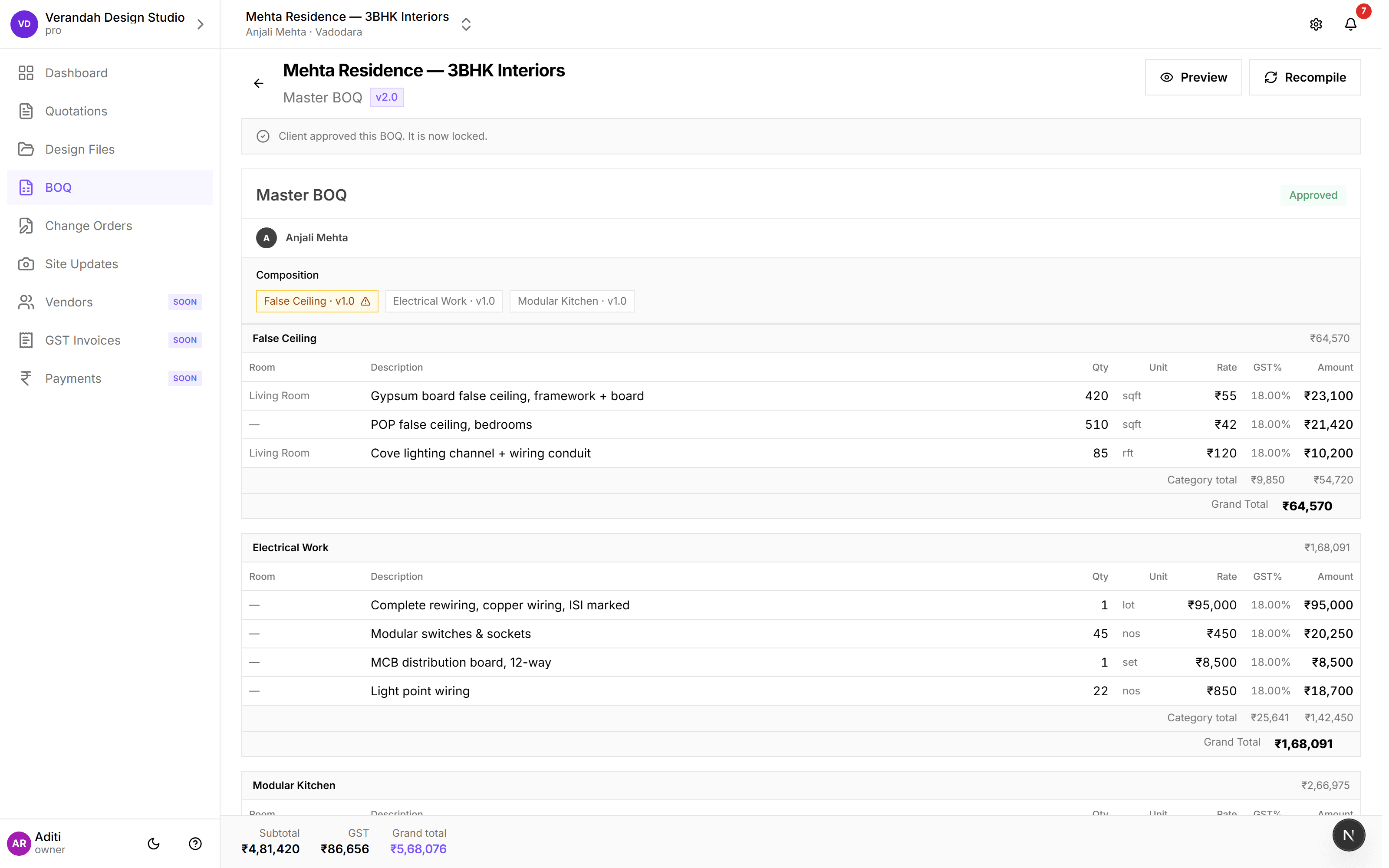
- Fold the change into the live scope - once approved, the change order's items need to actually update whatever your studio treats as the source of truth for the project (usually the Master BOQ), so the next invoice reflects reality instead of the original, now-outdated numbers.
Step 6 is where most manual processes quietly break. The change order gets approved, gets saved in a folder, and somebody has to remember to also go update the BOQ by hand - and on a busy week, that update is exactly the kind of thing that gets missed until the client points out the invoice doesn't match what was actually built.
Vismayum's Change Orders module is built around that exact gap: your studio approves internally first, then the client reviews and signs off with a signature drawn right in their own link - no login required. The moment they approve, a new Master BOQ version is compiled automatically with the change order's items already in it, so there's no manual step to forget.
See the Change Orders workflowCommon Change Order Mistakes Indian Studios Make
- Treating a WhatsApp "go ahead" as approval. It might be true that the client agreed - but a casual message has no price attached, no line items, and nothing that survives being scrolled past a week later.
- Pricing changes only at final billing. Batch-pricing every change order at the end of the project means the client sees a large, unfamiliar number all at once instead of a series of small, already-agreed additions.
- Forgetting to update the BOQ after approval. The change order gets filed, but the document the team is actually executing against and invoicing from doesn't reflect it - so the final bill doesn't match what was approved.
- No internal review before the client sees it. Sending a change order straight from site to client skips the one step that catches a wrong rate or a missing line before it becomes an awkward correction later.
- Not distinguishing chargeable changes from studio-side corrections. If something needs redoing because of a studio error, that's not a change order - billing it as one is what actually damages trust, versus a change order for something the client asked for or a site condition nobody could have seen.
A Simple Change Order Template Example
Here's what a properly documented change order looks like for a mid-project addition - in this case, a client asking to add a study nook to a bedroom that was already fully quoted:
| Room | Item | Reason | Qty | Rate (₹) | Amount (₹) | GST | Total (₹) |
|---|---|---|---|---|---|---|---|
| Master Bedroom | Study unit carcass | Client-requested addition | 24 sq.ft | 1,850 | 44,400 | 18% | 52,392 |
| Master Bedroom | Study unit shutters | Client-requested addition | 12 sq.ft | 2,100 | 25,200 | 18% | 29,736 |
| Master Bedroom | Extra electrical point | Site requirement for study lamp | 1 no. | 1,200 | 1,200 | 18% | 1,416 |
Net impact: +₹83,544 to the project total, approved by [client name] on [date], internally reviewed by [studio admin] on [date].
That's the whole structure - what, why, how much, and who signed off. Nothing here is more complicated than a BOQ line with one extra column for "why."
Frequently Asked Questions
What is a change order in interior design?
A change order is a documented, priced modification to work that's already been agreed - typically after a quotation or Master BOQ has been approved. It records what changed, why, the cost impact, and who approved it, turning a verbal or on-site decision into an official part of the project scope.
Is a WhatsApp message saying "go ahead" a valid change order?
Not in any way that holds up later. It might reflect a real agreement, but it has no price, no line items, and no reliable record if the client's memory of the conversation differs from yours by the time the final invoice arrives. A valid change order is a priced document with an explicit approval attached to it.
Who needs to approve a change order - just the client, or the studio too?
Both, and in that order. The studio should review and approve internally first - checking pricing and scope - before it's sent to the client. Only after internal approval should the client see it and give their own sign-off.
Does a change order need a signature to be legally meaningful?
A signature (or an equivalent explicit approval, like an approved link in a client portal) is what makes a change order defensible if there's ever a dispute. A verbal or casual-message approval is far weaker evidence of what was actually agreed.
How does an approved change order affect the BOQ or final invoice?
Once approved, a change order's items need to be reflected in whatever the studio treats as the current scope of record - usually the Master BOQ - so the next invoice matches what was actually built. If that update is done manually, it's easy to forget under normal project workload, which is the single most common way change orders and final invoices stop matching.
The Bottom Line
Change orders aren't a sign that a project is going badly - a project with zero change orders on it is rarer than one with a dozen, and usually just means changes were happening off the books instead of on them. The difference between a studio that protects its margin and one that quietly loses it isn't how many changes come up during execution. It's whether every one of them gets written down, priced, and approved before the work happens - not remembered, negotiated, and reconstructed after.