If you've been in a WhatsApp group named BOQ_final_v3_ACTUALFINAL.xlsx, you already know why this document deserves its own guide. A Bill of Quantities - BOQ for short - is one of the three or four documents that decide whether an interior design project makes money or quietly bleeds it out through mismatched vendor bills and forgotten revisions.
This guide covers what a BOQ actually is, how it's different from a quotation or estimate, what a properly structured one contains, and a step-by-step process for preparing one - written specifically for how Indian interior design studios operate, not generic construction tendering.
What Is a BOQ in Interior Design?
A Bill of Quantities (BOQ) is a structured, item-by-item document that lists every material, fitting, and work item required for an interior project - along with its specification, unit of measurement, quantity, rate, and total amount.
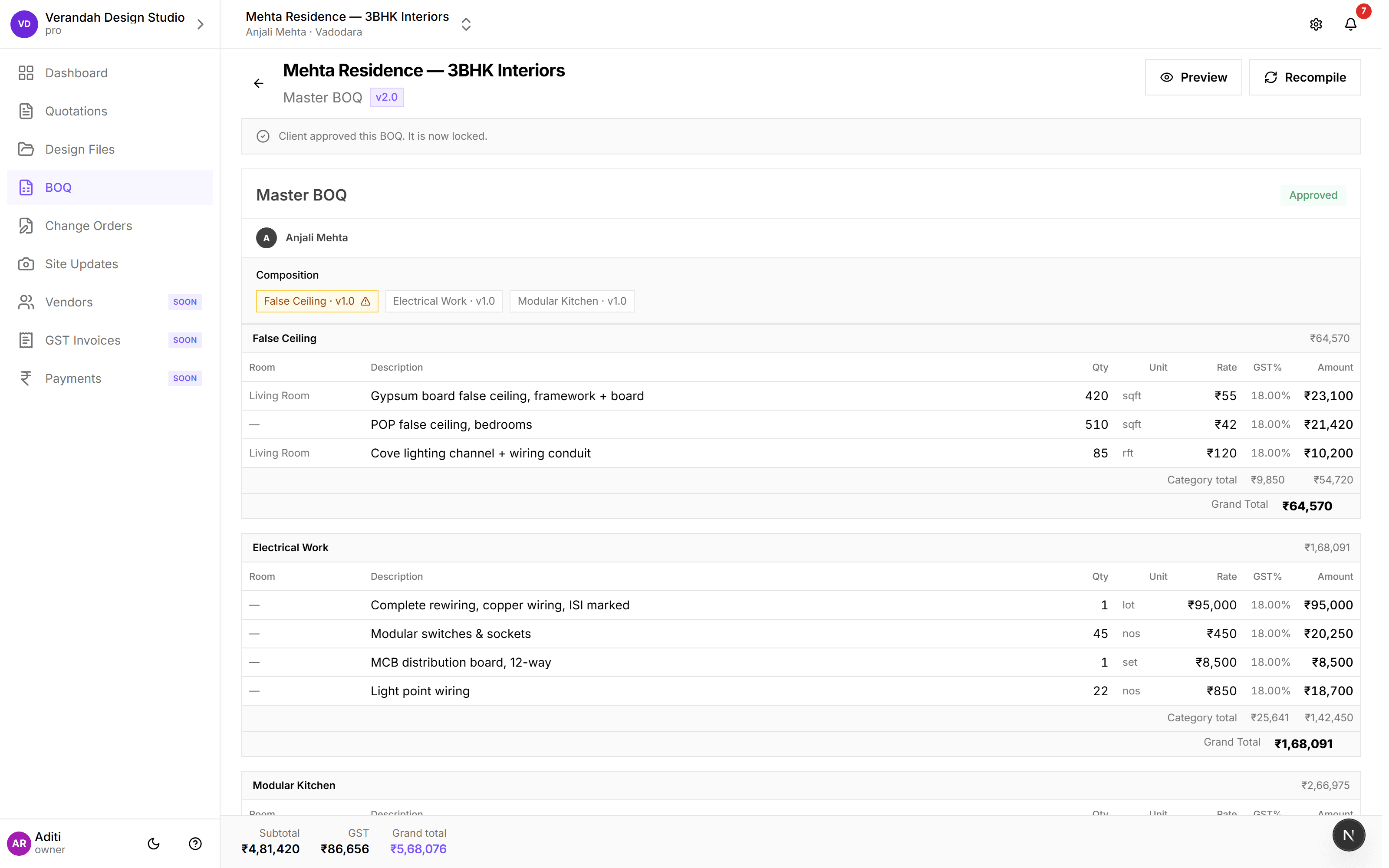
Where a quotation tells a client "modular kitchen: ₹4,20,000," a BOQ breaks that number apart: 18mm BWP plywood carcass at ₹1,850/sq.ft for 42 sq.ft, soft-close hinges at ₹180/piece for 24 pieces, quartz countertop at ₹1,650/sq.ft for 38 sq.ft, and so on - each line traceable back to a vendor, a rate, and a quantity.
That traceability is the entire point. A BOQ is what a designer, a site supervisor, a vendor, and a client can all look at and agree on the same number for the same reason - instead of arguing over a lump sum nobody can unpack.
Why BOQs Matter for Interior Design Studios in India
For studios running multiple residential and commercial fit-out projects at once, a BOQ isn't paperwork for its own sake - it directly protects margin and prevents disputes:
- Vendor negotiation gets sharper. Once every item has a quantity and a rate, you can compare vendor quotes line by line instead of comparing two unrelated lump-sum numbers.
- Site execution has a checklist. A supervisor working off a BOQ knows exactly what's supposed to arrive, in what quantity, and to what spec - catching short deliveries or spec substitutions before they become a client complaint.
- GST invoicing gets defensible. Most interior fit-out work and furniture items in India attract 18% GST, though the exact classification (works contract vs. goods vs. services) can shift this - always confirm with your CA. Either way, tax authorities and clients both expect line-item detail behind a bill, not a single number.
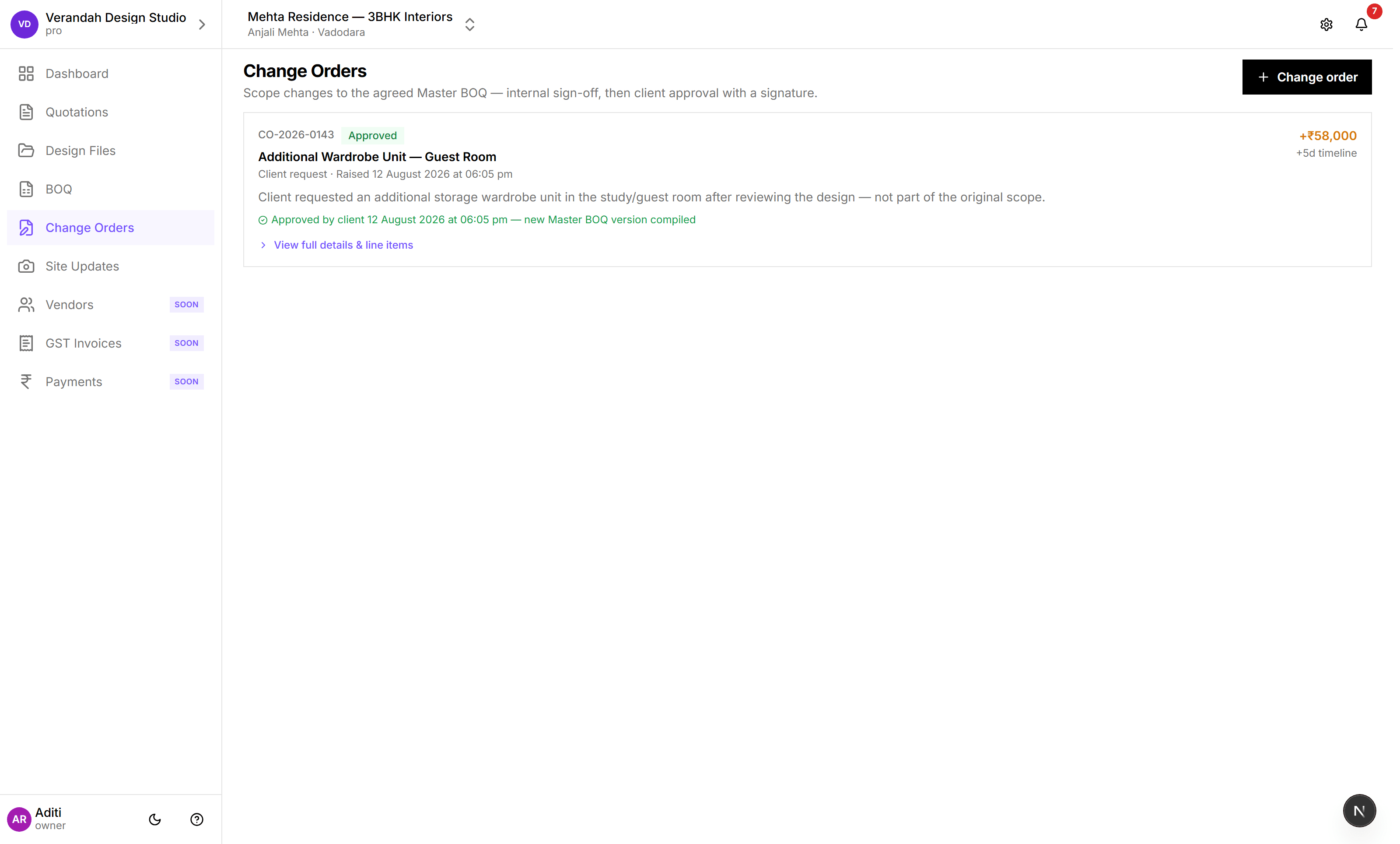
- Change orders become provable. When a client asks for a material upgrade mid-project, the BOQ is the baseline you're revising from - without it, "the client agreed to this extra cost" is just your word against theirs.
- Disputes get resolved with a document, not a memory. A signed BOQ is the closest thing an interior project has to a bill of materials - it's what you point to when a client asks "why did this cost more than what we discussed."
BOQ vs Quotation vs Estimate: What's the Difference?
This is the single most common point of confusion - including among studios that have been operating for years. Here's the distinction that actually holds up in practice:
| Estimate | Quotation | BOQ | |
|---|---|---|---|
| When it's made | Before design is finalised | After design & scope are agreed, before signing | After the client signs off, before execution starts |
| Audience | Internal / early client conversation | Client-facing, package-level | Client, site team, and vendors |
| Detail level | Rough, assumption-based | Grouped by room or package (e.g. "Living Room: ₹3,80,000") | Itemised - material, spec, unit, quantity, rate, amount |
| Changes easily? | Yes, expected to shift | Meant to be close to final | Revised formally, with a visible trail |
| Used for | Setting client expectations early | Winning the project / signing the contract | Execution, vendor POs, GST invoicing |
In short: an estimate is a guess, a quotation is a commercial offer, and a BOQ is the operational document that execution and billing actually run on. A quotation can exist without a BOQ (many studios skip straight to execution on a lump-sum quote), but doing that is exactly how "the vendor bill doesn't match what we quoted" disputes happen.
What Goes Into a Good Interior Design BOQ
A BOQ that's actually usable on-site - not just a document for the client's file - needs these fields for every line item:
| Field | Why it matters |
|---|---|
| Room / Area | Groups items so site teams and clients can navigate by space, not a flat 200-row list |
| Item description | Specific enough to order against - "Modular wardrobe shutter" is not enough; "18mm BWP ply, laminate finish, soft-close hinges" is |
| Specification / brand | Locks in quality - prevents a vendor quietly substituting a cheaper laminate mid-project |
| Unit | Sq.ft, running ft, piece, lot - whatever the item is actually measured and billed in |
| Quantity | Measured from drawings, not guessed |
| Rate | Per-unit vendor rate, kept current as vendors requote |
| Amount | Unit rate × quantity - the number that should reconcile with the vendor invoice later |
| GST | Applicable rate and amount, shown separately from the base amount |
| Vendor | Who's actually supplying or executing this line - useful the moment something arrives wrong |
| Revision / status | Whether this line is part of the original signed scope or a later addition |
That last field - revision status - is the one most Excel-based BOQs quietly drop, and it's the one that causes the most arguments later.
How to Prepare a BOQ for an Interior Design Project
- Start from finalised drawings, not sketches. A BOQ built off drawings that are still in flux will need a full rework the moment the layout changes - measure quantities only once the design is locked.
- Break the project down by room or zone. Living room, kitchen, bedrooms, common areas, MEP (electrical/plumbing) - this is how site teams and clients both navigate the document.
- List every item within each zone, with material, brand/spec, and finish - specific enough that a vendor could quote against it without asking follow-up questions.
- Measure or extract quantities from drawings - carpentry in sq.ft of shutter/carcass area, flooring in sq.ft, electrical points as a count, false ceiling in running ft or sq.ft depending on your convention.
- Apply current vendor rates, not last project's rates - material and labour costs shift often enough that a stale rate card is a common source of margin loss.
- Add GST per line (or per section, depending on how granular your invoicing needs to be) so the BOQ total reconciles cleanly with what you'll eventually invoice.
- Get client sign-off on the BOQ itself, not just the quotation that preceded it - this is what makes it enforceable later.
- Treat it as a living document. Every approved change gets added as a new, dated revision - not edited into the original row, which destroys the audit trail.
Common BOQ Mistakes Indian Studios Make
- Building the BOQ once and never updating it. Site conditions and client requests change constantly; a BOQ that isn't a living document stops being useful within the first fortnight of execution.
- Losing the revision history. When a change is edited directly into the original Excel row, there's no way to prove what the client actually agreed to and when - the single most common source of "but we never approved this" disputes.
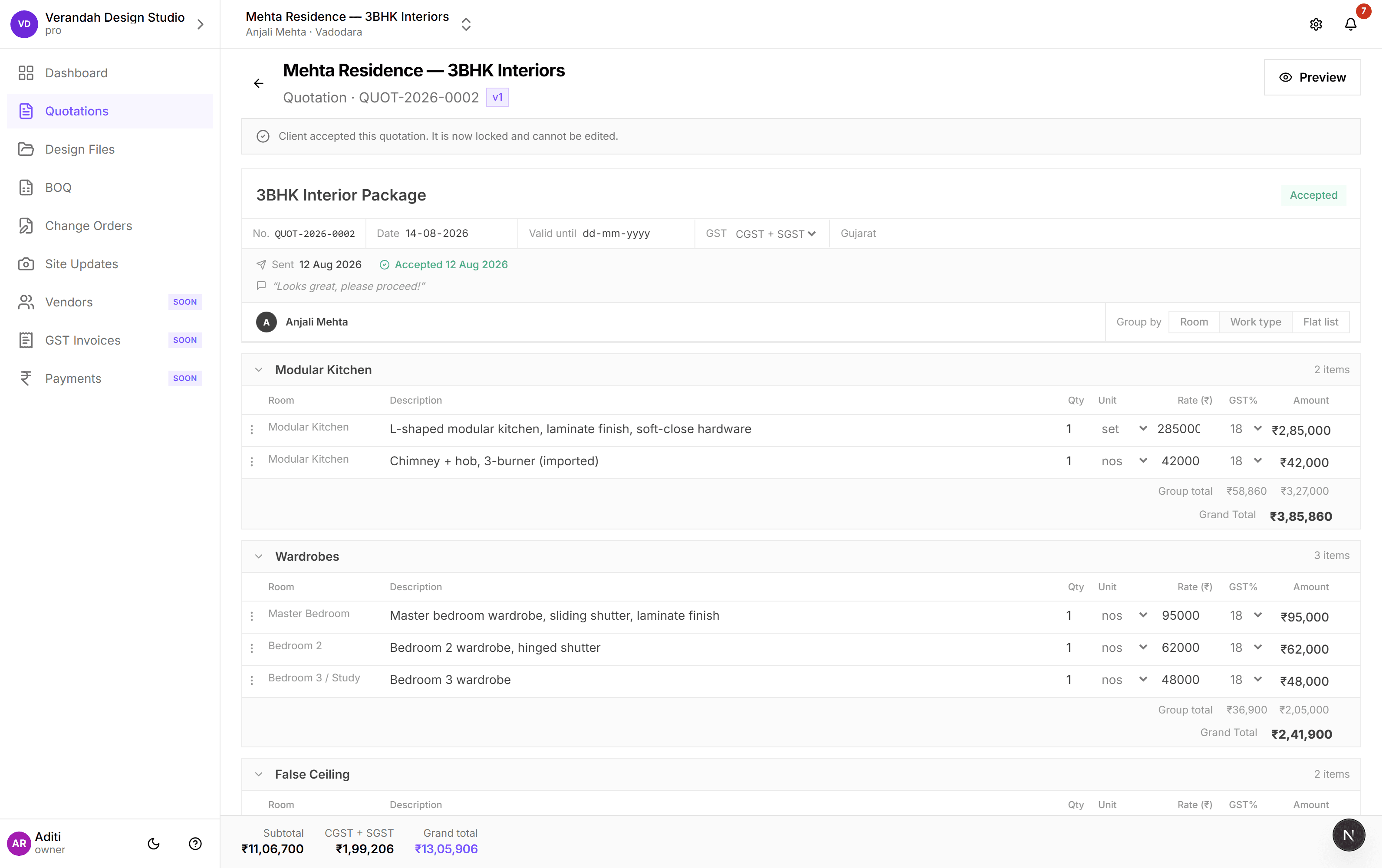
- No link back to the signed quotation. If the BOQ and the quotation live in two different files with no connection between them, nobody notices when they've quietly drifted apart - until a client cross-checks and asks why the numbers don't match.
- GST as an afterthought. Adding tax as a single number at the bottom instead of per line makes it much harder to produce a GST invoice that actually reconciles with the BOQ later.
- Version chaos.
BOQ_v1,BOQ_v2_revised,BOQ_FINAL,BOQ_FINAL_ACTUAL- familiar to almost every studio, and a genuine liability the moment two team members are working off different files.
Excel BOQs and the quotation they came from tend to drift apart the moment the first change order happens - and nobody notices until a vendor bill doesn't match. Vismayum's BOQ module keeps every line traced back to the signed quotation, with revisions timestamped automatically as changes are approved.
See the BOQ workflowA Simple BOQ Template Example
Here's what a properly structured line-item section looks like in practice - this example covers a portion of a living room carpentry scope. If you'd rather start from a ready-made file, download the free BOQ template - 12 pre-built trade categories with GST and totals already formulated.
| Room | Item | Spec | Unit | Qty | Rate (₹) | Amount (₹) | GST | Total (₹) |
|---|---|---|---|---|---|---|---|---|
| Living Room | TV unit carcass | 18mm BWP ply, laminate | sq.ft | 32 | 1,850 | 59,200 | 18% | 69,856 |
| Living Room | TV unit shutters | Matte laminate, soft-close | sq.ft | 18 | 2,100 | 37,800 | 18% | 44,604 |
| Living Room | False ceiling | POP with cove lighting | sq.ft | 210 | 95 | 19,950 | 18% | 23,541 |
| Living Room | Modular sofa upholstery | Fabric, foam density 32 | running ft | 14 | 3,200 | 44,800 | 18% | 52,864 |
Every row here answers the same four questions: what is it, how much of it, at what rate, and what does the client owe including tax. That's the whole discipline of a good BOQ - nothing more complicated than consistently answering those four questions, room by room, for the entire project.
Frequently Asked Questions
Is a BOQ the same as a quotation?
No. A quotation is a package-level commercial offer made before a client signs - usually grouped by room or category. A BOQ is the itemised execution document that follows, breaking each package down into material, quantity, rate, and GST for every line.
Who prepares the BOQ - the designer or the contractor?
In most Indian interior design studios, the design team or a dedicated estimator prepares the BOQ, using vendor and contractor rates as inputs. On larger commercial projects, a quantity surveyor may prepare it instead - but for residential interior fit-outs, it's typically an in-house studio function.
Does a BOQ need a GST breakup?
Yes, if you intend to invoice against it. Adding GST as a single number at the end instead of per line makes it far harder to reconcile the BOQ with the GST invoice you eventually raise - and harder to defend the invoice if a client questions it.
Is a BOQ legally binding?
A BOQ isn't a contract by itself, but once a client signs off on it, it functions as the agreed technical and commercial scope - the document both sides refer back to if a dispute arises over what was included and at what price.
What format should a BOQ be in - Excel or dedicated software?
Excel works for a single small project, but it has no built-in way to track revisions, tie a BOQ back to the quotation it came from, or feed directly into a GST invoice - all of which become real problems the moment a studio is running more than one or two projects at a time.
The Bottom Line
A BOQ is only as useful as its ability to stay accurate through the life of a project - every change tracked, every line traceable back to the quotation and forward to the invoice. Most of the disputes and margin leaks studios deal with don't come from a badly made BOQ; they come from a good one that stopped being updated three weeks into execution.
For more on the Bill of Quantities concept as used in construction and tendering more broadly, Wikipedia has a solid overview of its origins and use outside interior design specifically.